Breaking news - www.breakingnews.com

0 Why the Pentagon’s New Fighter Jet Will Now Cost More Than $1 Trillion

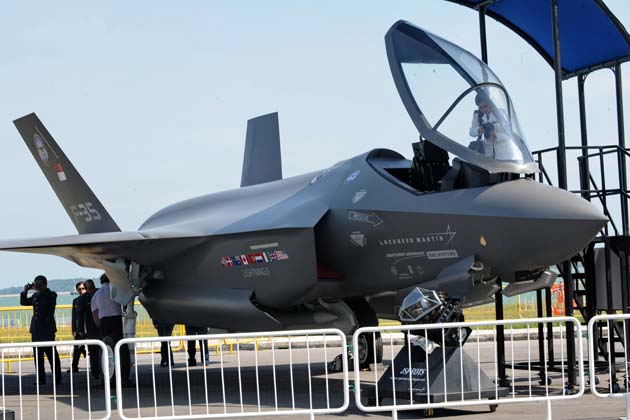
The F-35 Joint Strike Fighter is the Pentagon’s big plan for future warplanes — it’s slated to replace nearly all of the other tactical jets in the Air Force, Navy and Marine Corps. But getting there is going to be slow and expensive, as a new government report details.
The JSF program is a massively expensive undertaking. It has cost the government $400 billion to date, and is estimated to run more than $1 trillion to develop, buy and support nearly 2,500 aircraft through 2050.
A major problem, according to the Government Accountability Office report, is that the program is charging ahead with procurement while testing is still in progress. As Michael Sullivan, one of the report’s authors, told Congress, “the manufacturing processes are just never able to get stable because there's so much information coming in from testing and so many engineering changes that are going on.”
In a statement to Congress, the Pentagon officials in charge of the F-35 program said they "have put the program on sound footing for the future" but acknowledged that there was "no more money to put against contract overruns or problems."
The GAO report was notably stern. Here are some of its findings.
Only a portion of testing is finished:
Even though the design is not considered “mature,” production proceeds largely apace:
This leads to extra costs as already constructed planes have to be retrofitted:
The JSF’s software still needs work. Sullivan told Congress that “the development of the software that they need to make this aircraft fully combat capable is still as complex as anything on earth.”
“Supplier performance problems” and changes from testing have caused Lockheed Martin, the plane's manufacturer, to fall behind on production:
Because of safety and other engineering concerns, the Pentagon has reduced the number of planes it is ordering in the near future. But the program is still expected to cost more than $13 billion a year through 2035, and be an ongoing budget struggle for the Pentagon:

Source:http://www.propublica.org/article/why-pentagons-new-fighter-jet-will-cost-more-than-1-trillion

0 Israel says threat of strike on Iran is working

The threat of a military strike on Iran is preventing the Islamic republic from taking the final steps towards developing a nuclear bomb, Israeli Defence Minister Ehud Barak said on Thursday.
"We are seeing with our own eyes the reason why Iran, which really wants to achieve a military nuclear capability, is not taking some of the steps defined by the IAEA as breaking the rules, why it is not breaking out," he told public radio, referring to the UN's International Atomic Energy Agency.
"One of the reasons is the fear of what will happen if, God forbid, the United States or maybe someone else acts against them," Barak said, referring to the threat of an air strike against Iran's nuclear facilities.
Israel sees an Iranian nuclear weapon as a threat to its existence, and believes Tehran may be on the cusp of "break out" capacity -- the moment when it could quickly produce weapons-grade uranium.
With Iran shifting its core nuclear facilities into protected underground sites, Israel fears Tehran is moving into the so-called "immunity zone," and has warned a military strike may be the only way to prevent the Islamic republic from obtaining a nuclear weapons capability.
Although the Obama administration has made clear it would not hesitate "to use force" where necessary, it has also said it opposes an attack for now, and wants time to let a new round of sanctions take effect.
AF
Two words......"Dimona" & "Unregulated " Try Googling them together. 

0 Israeli settlers blocking water access for Palestinians, says UN Report

When Palestinian farmer Jamil Darawsheh dipped his hands into the waters of a natural spring near his village this week, it was the first time he had done so in 10 years.
Palestinian farmer Jamil Darawsheh says Israeli settlers near the West Bank village of Awarta have blocked access to natural springs, which are critical sources of waters.
He says he’s been too afraid to visit the site because of the threats and intimidation from Israeli settlers who live nearby.
A United Nations report released this week to coincide with World Water Day (March 22) found that Israeli settlers are blocking access to 30 natural springs – critical sources of water in the West Bank. The U.N.’s Office for the Coordination of Humanitarian Affairs also identified another 26 springs where Palestinians have limited access, because settlers are trying to exert control.
The spring sits high atop a hill, overlooking the Palestinian village of Awarta, not far from Nablus. Water trickles slowly from a spout into a rock-walled reservoir before making its way down to the fertile land in the valley below.

Darawsheh says he used to use this water to irrigate his olive trees on land surrounding the spring.
“Not one Palestinian from this village is using this water now,” he says. “When I look at this water, I see my land drying up, and I’m unable to help. It leaves me very bitter.”
Awarta residents say Israelis living in the nearby settlement of Itamar use the water to irrigate their own fields, while threatening Palestinians who try to access the resource for their own purposes.

Communities in conflict

Relations between the two communities are beyond bitter. The Palestinians say three men from the area have been killed by settlers in recent years. A year ago, five members of an Itamar family were killed in their homes. Two Palestinian cousins from Awarta are serving multiple life sentences for the crimes.
For the Palestinians, the spring is a symbol of how the Israeli occupation continues to affect their daily lives.
“We used to use this water. [The spring] was a great source of water for us. But whoever thinks of using it now is risking his or her life,” says Sami Awad, who heads the village council in Awarta.
Sami Awad, who heads the village council in the West Bank village of Awarta, says anyone who considers using the natural spring is risking his or her life. Sami Awad, who heads the village council in the West Bank village of Awarta, says anyone who considers using the natural spring is risking his or her life. (Derek Stoffel/CBC)
Conflicts between settlers and Palestinians happen regularly. The U.N. accuses settlers of not only blocking water resources but burning Palestinian olive groves and using threats and violence to keep farmers off their land.
“I think it’s very serious,” says Ramesh Rajasingham, who runs the U.N.’s Office for the Coordination of Humanitarian Affairs in the occupied Palestinian territories.
“Many farmers are either forced to cease cultivating the land as a result of the takeovers of the springs, or face a reduction in their productivity. So obviously they can’t irrigate as much as they would like to,” Rajasingham told CBC News.
Darawsheh estimates he has lost about 10,000 Israeli shekels ($2,600) because he was unable to irrigate new olive seedlings on his land. “This is an extreme case [of] how the occupation treats us with an iron fist.”

Springs as tourist attractions

The UNOCHA report states that the takeover of the springs appears to be another example of Israel’s efforts to exert more control over the West Bank, which the Palestinians want for a future state.
UNOCHA also says some settlers are trying to takeover springs by turning them into tourist attractions, by adding park benches and picnic tables and providing parking lots for visitors.
Rajasingham says not only is that illegal, but “when you have something like this and you encourage tourism – it somehow makes the situation seem normal.”
Israel’s military-run Civil Administration in the West Bank says the report is “distorted, biased and full of inaccuracies.”
“It must be emphasized that Israel completely fulfills its part in the water agreements signed” with the Palestinian Authority, a spokesman for Civil Administration wrote in a statement to CBC News.
Farmer Jamil Darawsheh doesn’t expect the U.N. report will change the settlers’ behavior. But he is optimistic nonetheless.
“One day hopefully we will be able to use this water. As long as we stay on our land, we shall persevere.”

0 Mysterious Sounds And Rumble Now Being Reported In Montello, 80 Miles South of Clintonville


0 For the second straight night, mysterious "booms" have caused homes in Clintonville to shake.

Dozens of homeowners called police last night to report more blasts and tremors
Police tell us the booms are getting bigger and more intense.  The area where this is happening is in the northeastern part of the city. 
On Monday, police, fire and utility crews spent most of the day looking for the source but so far no one has an answer.  City leaders say there is no mining or explosive companies operating in the area.  The military added it was not doing anything to cause any sort of booming sound.  In the meantime, official continue to monitor the scene and are asking residents to call police if they see or hear anything unusual.


Source:http://www.nbc26.com/news/local/143461616.html 


0 Fake YouTube Site Targets Syrian Activists With Malware

Fake YouTube Site Targets Syrian Activists With Malware

Last week, EFF reported on two instances of pro-Syrian-government malware targeting Syrian activists through links sent in chats and emails. This week, we've seen new Windows malware dropped by a fake YouTube site hosting Syrian opposition videos.
Below is a screenshot of the fake YouTube page, which attacks users in two ways: it requires you to enter your YouTube login credentials in order to leave comments, and it installs malware disguised as an Adobe Flash Player update.
This phishing site has been taken down, but if you encounter a similar page do not enter your YouTube login credentials to comment. If you have already logged in to the site (or a similar site) to leave a comment follow the steps outlined below to see if your computer has been infected, and change your YouTube and Gmail passwords from an uninfected computer immediately. You may also wish to take some additional steps to make sure that your Gmail account is secure, including enabling 2-factor authentication and checking to see if any suspicious forwarding addresses or delegated accounts have been added to your account.
If you encounter a similar page do not click "Install" to update Flash. Clicking "Install" drops a file called setup.exe. This is a .NET file and .NET is required to run it. Once it is installed, the dropper connects back to an address in Syrian IP space and downloads additional malware, which gives the attacker administrative access to your computer.
To see if you have been infected, look for the following files:
These files are "system files" and will not be visible by default. To change your settings to make system files visible in Windows 7, Start-->Control Panel-->Appearance and Personalization-->Show hidden files and folders, then select the radio button called Show Hidden Files, Folders, and Drives. Remove the checkbox labeled "Hide extensions for known file types." Remove the checkbox labeled "Hide protected operating system files."
C:\Documents and Settings\Administrator\Local Settings\Temp\sysglobl.exe
C:\Documents and Settings\Administrator\Local Settings\Temp\mscordbc.exe
On Windows 7 systems, you can find them here:
C:\Users\Administrator\AppData\Local\Temp\sysglobl.exe
C:\Users\Administrator\AppData\Local\Temp\mscordbc.exe
You can see both files in the screenshot below:
What do do if your computer is infected:
If your computer is infected, deleting the above files does not guarantee that your computer will be safe or secure. This attack eventually gives an attacker the ability to execute arbitrary code on the infected computer. There is no guarantee that the attacker has not installed additional malicious software while in control of the machine. The safest course of action is to re-install the operating system on your computer and change all passwords to accounts you may have logged into while the computer was infected.
EFF is deeply concerned about this pattern of pro-government malware targeting online activists in authoritarian regimes. We will continue to keep a close eye on future developments in this area.

2 Connecticut Advances RFID License Plate Legislation

Connecticut Senate Transportation Committee backs bill to explore implanting electronic tracking chips on license plates.
Paul Scully-PowerA lobbyist for the Radio Frequency Identification (RFID) industry has convinced Connecticut legislators to consider implanting spy chips on the state's license plates. Last Wednesday, the state Senate Transportation Committee voted unanimously to pass a bill asking the Department of Motor Vehicles to create a report on the implementation of RFID for motor vehicle registration by January 1.

Implanting the chips on license plates would enable real-time monitoring of all vehicles by positioning tracking stations at key points throughout the state. The main interest behind the bill is to generate automated ticket for drivers whose vehicle registration, emissions or insurance certification may have lapsed for a day or two. RFID makes photo enforcement systems far more accurate. Instead of having optical character recognition software identify vehicles from a picture of a license plate -- often guessing when images are unclear -- the chips would broadcast vehicle identity to nearby stations under all weather conditions.

Former astronaut Paul Scully-Power brought the idea to the attention of lawmakers. Scully-Power stands to profit significantly should the technology be adapted at the state level, as he is the former CEO of Mikoh Corporation and SensorConnect Inc, both of which sell RFID solutions. Scully-Power's written testimony to highlighted how legislators would fare equally well by adopting the technology.

"There are two main reasons for the Department of Transportation to adopt this type of program," Scully-Power wrote in his testimony. "One, to validate that every vehicle conforms to state regulations. Two, to provide considerable income to the state by identifying vehicles that are violating the existing laws of Connecticut.... The state would collect $29,619,500 per year or $79,858,500 in the same three-year period compared to the $594,000 it was able to collect."

The financial estimates were based on the number of uninsured drivers the system could hit with $100 tickets. The system also would increase the profitability of red light cameras, which the legislature is currently considering authorizing.

"An RFID program would be phased in gradually and then expanded to accomplish other policing tasks without having to change equipment," Scully-Power wrote. "The second phase would be to implement speeding violations."

A copy of the legislation is available in a 210k PDF file at the source link below.

Source: PDF File Senate Bill 288 (Connecticut General Assembly, 3/14/2012)

0 TSA Nabs Suspected Al Queda Terrorist At O'Hare International Airport, A toddler in a wheelchair


A toddler in a wheelchair is stopped by the TSA at ORD (O'Hare Airport in Chicago) and forced to into a sequestered area. On his way to a family vacation in Disney, this 3 year old boy is in a body cast for a broken leg. Despite assurances from his father that "everything is ok", he is physically trembling with fear while he watches his two siblings, mother, father, grandfather and grandmother pass through along with everyone else...only to be singled out. 

He simply does not understand what is happening or why.