
0 Government Explained
An inquisitive alien visits the planet to check on our progress as a species, and gets into a conversation with the first person he meets. The alien discovers that we live under the rule of a thing called "government", and wants to understand more about what "government" is, what it does, and why it exists.
Produced and voiced by Graham Wright, based on part of the talk by Larken Rose at the Free Your Mind Conference 2011, which can be found here:http://www.youtube.com/watch?v=2bCz9gcvMfk


0 Al Qaeda Bomb Rant Pilot Tackled By Plane Passengers
The captain of a US airliner was tackled by his own passengers after he ran up and down a packed jet screaming about bombs and al Qaeda.
 The JetBlue plane, en route from New York's JFK airport to Las Vegas, was forced into an emergency landing in Amarillo, Texas, as the pilot was pinned down.
Alarmed passengers became aware of the incident when the co-pilot, seemingly worried by his colleague's erratic behavior, locked him out of his own cockpit when he left to use the toilet.
The captain - believed to be Clayton Osbon - responded by banging angrily on the flight deck door, before running up and down the aisle screaming, "Say your prayers!" according to the New York Post.
A Federal Aviation Administration (FAA) statement said: "The co-pilot became concerned that the captain exhibited erratic behavior during the flight.
"The captain had exited the cockpit during the flight, after which the co-pilot locked the door.
"When the captain attempted to enter the locked cockpit, he was subdued by passengers.
"After the flight landed safely, local law enforcement secured the pilot and he was transported by ambulance for medical evaluation."
A JetBlue statement said that roughly three and a half hours into the flight, "the pilot in command elected to divert to Amarillo, Texas, for a medical situation involving the captain.
"Another captain, travelling off duty, entered the flight deck prior to landing at Amarillo, and took over the duties of the ill crew member, who was taken to a local medical facility in Amarillo."
A JetBlue statement said that roughly three and a half hours into the flight, "the pilot in command elected to divert to Amarillo, Texas, for a medical situation involving the captain.
"Another captain, travelling off duty, entered the flight deck prior to landing at Amarillo, and took over the duties of the ill crew member, who was taken to a local medical facility in Amarillo."
Passenger David Gonzalez told Fox News how Osbon ranted incoherently about Iran then moved towards an emergency exit.
Mr Gonzalez responded by making a grab for the captain and managed to choke him until he collapsed.
"I told him I'm gonna show you what Iran is like and I grabbed him and choked him," said Mr Gonzalez.
"I was able to choke him with my forearm. At that time I let go of his throat and tackled him to the floor."
"We were afraid he'd wake up," added Mr Gonzalez.
Passenger Tiffany Lee tweeted: "Our pilot went nuts and we had to land in Amarillo.
"I saw my life flash before my eyes today."
Grainy YouTube footage taken by one passenger after the plane landed showed a scrum at the front of the aircraft.
In the footage an attendant reminds people to stay seated and scolds them for taking video, saying: "We don't need pictures of this, please."
A JetBlue spokeswoman said all passengers will be reimbursed for the flight and receive a credit for twice the value of their ticket.
The US attorney's office in North Texas will decide whether charges will be filed.
Osbon's distraught wife of six years, Connye Osbon, said she did not "have a clue" what had happened aboard the plane, in comments to ABC News.
"There are several different sides to every story. Just keep that in mind," she cautioned, adding that she had not spoken to her husband since the incident.
Source:http://uk.news.yahoo.com/emergency-us-plane-pilot-goes-nuts-224047776.html
Source:http://uk.news.yahoo.com/emergency-us-plane-pilot-goes-nuts-224047776.html

0 MoD tells Gulf War veteran his army medical records have been lost

A GULF War veteran seeking a war pension after suffering from a catalogue of illnesses since serving in the first conflict in Iraq has told how his army medical records have mysteriously gone missing.
Colin Beswick, who served as a corporal with the 7th Tank Transporter Regiment, made a Freedom of Information request to the Ministry of Defence (MoD) for his health notes.
Colin Beswick, who served as a corporal with the 7th Tank Transporter Regiment, made a Freedom of Information request to the Ministry of Defence (MoD) for his health notes.
But the 48 year-old dad of two was shocked when the response missed out records covering his six month tour of Iraq in 1991.
Yet the rest of his notes covering his time in the army – from 1979 to July 1990 and from November 1992 to 1994 – were included
Colin said that when he spoke to an MoD official on the phone about the missing records he was told that they had been destroyed in a fire.
And Colin said he knows of other Gulf War veterans who have been told the same.
And Colin said he knows of other Gulf War veterans who have been told the same.

Since serving in Iraq Colin has suffered an infection which left him deaf in one ear and he has been diagnosed with Barrett’s Oesophagus, a condition where acid burns the lining of the oesophagus, changing their cellular structure and increasing the risk of cancer.
This gives Colin constant heartburn and chest pains.
He has also developed fibromyalgia, a chronic pain condition which makes his body ache so much he struggles to dress himself and he has sleep apnoea which causes him to stop breathing during his sleep.
On top of his physical problems Colin said he is battling Post Traumatic Stress Disorder (PTSD) which causes him to have nightmares and flashbacks.
This gives Colin constant heartburn and chest pains.
He has also developed fibromyalgia, a chronic pain condition which makes his body ache so much he struggles to dress himself and he has sleep apnoea which causes him to stop breathing during his sleep.
On top of his physical problems Colin said he is battling Post Traumatic Stress Disorder (PTSD) which causes him to have nightmares and flashbacks.
He blames his poor health on a cocktail of drugs given by army doctors while serving in the Gulf to protect him against chemical attacks.
The conflict has become known as the ‘most toxic war in history’ due to the high number of soldiers who have suffered health problems.
Colin is launching a claim for a war pension with the help of the National Gulf War Veterans and Families (NGWVF) charity.
“You can’t make it up,” he told the Sunday Mercury. “This has really angered me.
“They’ve got everything, except the period I was in the Gulf.
“That’s the same for loads of people I’ve spoken to.
“The MOD told me on the phone they had a fire, it is amazing they had a fire for those particular notes and not the rest.
“It is just away of the concealing what happened.”
Colin said his PTSD was brought on by his unit’s grim task of clearing dead men from destroyed Iraqi tanks on the notorious Basra Road.
“For years I could not stand the smell of meat as it brought back the smell of burning bodies,” he said.
“That road was horrific. There were so many destroyed vehicles which had been hit by our aircrafts’ missiles. Often you actually be able to make out the bodies but the smell was awful. We had to get the wrecks on to trailers and take them away.
“Physically I feel like a 90-year-old man.
0 IDF Soldiers Invite You to "Like" us on Facebook [FIXED]
IDF soldiers invite you to "Like" us on Facebook. [FIXED]
Original video: http://www.youtube.com/watch?v=lttxQ6T1DCI
0 How to Make Drones Scarier: Make Them Nuclear Powered
Government scientists find it "disappointing" that “current political conditions will not allow use" of a nuclear-powered drone that can fly around the Earth for months.

We do not. Why? Because the mere thought of a nuclear reactor flying around the heavens, snapping pictures of villages and possible firing rockets at them is absolutely horrifying, that's why. Set aside the fear of a nuclear reactor crashing in your yard — these would be drones that would not run out of power.
ProPublica's Justin Elliott just posted a set of documents (PDF) from the Sandia National Laboratory in New Mexico dated June 2011 that detail the development and testing of said nuke drones. With the help of scientists from Northrop Grumman, the scientists mapped out the feasibility of building such an aircraft, not only from a technical point of view but, apparently, a political one too. The military benefits of such a weapon tool are pretty clear: Building a nuke drone would make it possible “to increase [unmanned aerial vehicle] sortie duration from days to months while increasing available electrical power at least two-fold." That's where the nuclear power comes into play. As Steven Aftergood points out on the FAS Project on Government Secrecy's blog:
The project summary, which refers to "propulsion and power technologies that [go] well beyond existing hydrocarbon technologies," does not actually use the word "nuclear." But with unmistakable references to "safeguards," "decommissioning and disposal," and those unfavorable "political conditions," there is little doubt about the topic under discussion.
There are really two ways of reacting to this news. One, good for the government scientists for deciding not to build a flying, unmanned nuclear power plant. (Bear in mind that we don't actually know if they've continued work on the project since last June.) Two, let's make this a teaching moment. Last December when CIA lost a drone over Iran was a teaching moment, too. Just imagine if it had an American-made nuclear reactor inside of it.
0 Why the Pentagon’s New Fighter Jet Will Now Cost More Than $1 Trillion
The F-35 Joint Strike Fighter is the Pentagon’s big plan for future warplanes — it’s slated to replace nearly all of the other tactical jets in the Air Force, Navy and Marine Corps. But getting there is going to be slow and expensive, as a new government report details.
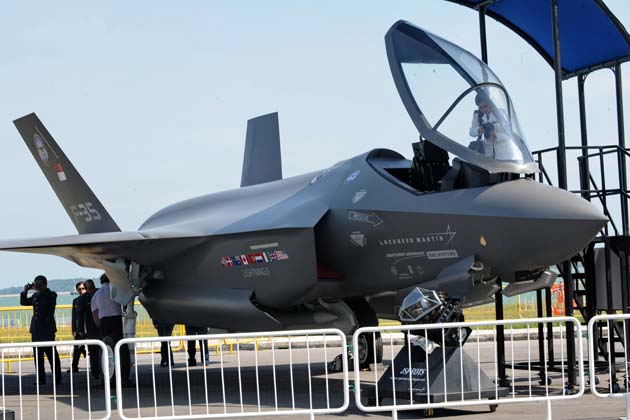 The JSF program is a massively expensive undertaking. It has cost the government $400 billion to date, and is estimated to run more than $1 trillion to develop, buy and support nearly 2,500 aircraft through 2050.
A major problem, according to the Government Accountability Office report, is that the program is charging ahead with procurement while testing is still in progress. As Michael Sullivan, one of the report’s authors, told Congress, “the manufacturing processes are just never able to get stable because there's so much information coming in from testing and so many engineering changes that are going on.”
In a statement to Congress, the Pentagon officials in charge of the F-35 program said they "have put the program on sound footing for the future" but acknowledged that there was "no more money to put against contract overruns or problems."
The GAO report was notably stern. Here are some of its findings.
Only a portion of testing is finished:

Even though the design is not considered “mature,” production proceeds largely apace:


This leads to extra costs as already constructed planes have to be retrofitted:

The JSF’s software still needs work. Sullivan told Congress that “the development of the software that they need to make this aircraft fully combat capable is still as complex as anything on earth.”

“Supplier performance problems” and changes from testing have caused Lockheed Martin, the plane's manufacturer, to fall behind on production:

Because of safety and other engineering concerns, the Pentagon has reduced the number of planes it is ordering in the near future. But the program is still expected to cost more than $13 billion a year through 2035, and be an ongoing budget struggle for the Pentagon:

Source:http://www.propublica.org/article/why-pentagons-new-fighter-jet-will-cost-more-than-1-trillion
Subscribe to:
Posts (Atom)