Russia Today telling it like it REALLY is....

0 Western media bias muddies waters in Syrian conflict


0 Welcome to the future, Virtual supermarkets come to Birmingham [+video]
We recently published an article about Tesco opening a virtual supermarket in Korea, now Ocado is trialling the concept in the UK.
The revolutionary virtual shopping wall has been trialled in London and Bristol and now in Birmingham’s Bullring.
Using its popular Ocado on the Go app, customers can purchase any of
the items on display in the virtual window simply by scanning them with
their smartphone.
Jason Gissing, Ocado Co-Founder, said: “We could not be more excited
about bringing our virtual window shopping experience to the Bullring.
Birmingham has long been Britain’s Second City, and with so many of our
dedicated customers living in the area it makes perfect sense to take
our virtual store to their doorstep.”
The trial store will be in the Bullring until August 15.
Ocado first hit the high street last August at the One New Change
shopping centre in central London, followed by a similar installation at
Bristol’s Cabot Circus in November 2011. It was the first time that
Ocado, a strictly online business, had migrated from the internet to
bricks and mortar.
Ocado introduced the world’s first supermarket shopping mobile
application on iPhone in 2009 adding Blackberry and Windows Phone 7
handsets in 2011.
To check out Ocado’s virtual shopping wall for yourself, head down to
the Bullring shopping centre, just don’t forget your smartphone!
Source: The Information Daily

0 Iran’s UN Envoy Says Israel behind Bus Blast in Bulgaria
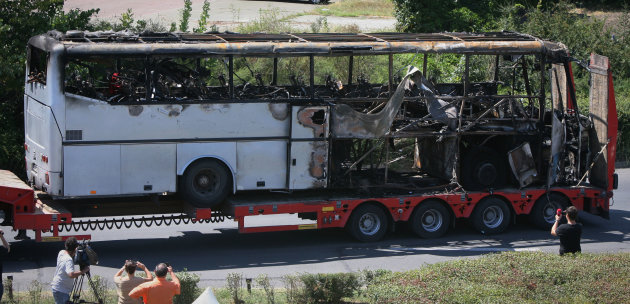
Iran’s UN envoy Mohammad Khazaee said on Wednesday that it was Israel
that plotted and carried out a terrorist attack on an Israeli tourist
bus in Bulgaria last week.

On July 18, a suicide bomber entered a bus with 40 Israeli tourists
at a parking lot of the airport in the resort town of Burgas and blew
himself up killing five Israelis and a Bulgarian driver and wounding
over 30 people.
“Such terrorist operation could only be planned and carried out by
the same regime whose short history is full of state terrorism
operations and assassinations aimed implicating others for narrow
political gains,” Khazaee said at a UN Security Council debates on the
Middle East.
Soon after the terrorist attack Israeli Prime Minister Benjamin
Netanyahu condemned the blast as “an Iranian terror attack” and promised
to retaliate with tough measures.
“It's amazing that just a few minutes after the terrorist attack,
Israeli officials announced that Iran was behind it,” Khazaee said
adding that Iran would never engage “in such a despicable attempt on ...
innocent people.”
According to earlier Bulgarian media reports, the suicide bomber could be a former inmate of the U.S. Guantanamo prison in Cuba, identified as identified 33-year-old Swedish citizen of Algerian origin Mehdi Ghezali.
Related News
Iran Rejects Israeli Accusations over Bus Blast Links
Multimedia
0 Does the UK currency feature a hidden subliminal message?
Does the UK currency have a hidden subliminal image?
This post is not something I've researched much, have much knowledge on or want to cover in any depth. But I felt I needed to post something about what I "think" I've found all the same.
The premise is based largely on the content of a very interesting and well put together blog I stumbled across awhile ago that can be found here:
This movie also covers the every aspect of the subject
Anyway, while handing over some of the "pretty paper" we in the UK call cash, the following image just suddenly stuck out plain as day...and I've honestly no idea why.
 |
| Click here For Highlighted Reveal |
So has the Queen always had "SeX" in her hair?
0 Searching for the truth in Army private's death
Army Pvt. Thomas Lavrey should be alive and getting ready to leave
the service. Instead the 21-year-old is back home in Machias, buried in
the local cemetery.
 |
| Dale Lavrey pulls weeds beside the grave of his son, |
Army Pvt. John-Brian Hughes is in Fort Leavenworth prison, charged with murdering Lavrey.
In the weeks before he was accused of plunging a knife into Lavrey’s
neck at Fort Riley, Kansas, the 25-year-old spoke of mysterious people
following him and his phone being tapped, but the Army ignored his pleas
for mental health assistance, a relative said.
Now two families, one in Winchester, Va., and the other in Machias,
are dealing with two faces of the tragedy and growing angrier by the day
at the Army for failing to heed the warning signs of a soldier – with
an affinity for knives – who was about to go off the deep end.
“I can’t tell you how much I feel for the Lavrey family. It is
breaking my heart that their son was lost. This should have never
happened,” said Brian Hughes, the father of the accused soldier. “We
trusted our kids to the same government."
There is mutual sympathy from the Lavreys, who first learned of their
son’s slaying in May through an anonymous phone call apparently made by
another soldier at Fort Riley, home to the Army’s famed Big Red One –
1st Infantry Division.
“I am sure that Mr. Hughes did not raise his son to be a murderer. We
buried our son, and he lost his son, too,” Dale Lavrey said just
moments before making the short drive earlier this week to visit his
son’s grave at Maplegrove Cemetery.
Lavrey says there is no question the Army did not take appropriate action that could have prevented the killing.
“I think this guy Hughes should have been on 24-hour surveillance. He
had been seeking counseling since the beginning of April when the Army
had taken his knife collection away from him,” Lavrey said of
information he received from Fort Riley’s Criminal Investigation
Division. “Somebody slipped.”
Brian Hughes said his son sought help but was denied.
“… He had a psychological exam on April 19 and following the exam,
the Army sent someone to his home off base and confiscated his knife
collection. It kills me that they took it seriously enough to go and get
his knife collection,” Hughes said of his son who served in the Iraq
War and in Kuwait. “The reason for the psychological exam was to begin
the process of finding him an unfit soldier and forcing him out.”
As his son’s mental condition deteriorated in recent months, Hughes
said his family called Fort Riley to try to convince base officials to
help John-Brian.
“On May 5, my son told us his phone was being tapped,” Hughes said.
“Then he told his sister on May 7 that he was being followed for a
couple of weeks. I was getting text messages from him on how he was
collecting evidence to protect himself from them. He wouldn’t tell me
who ‘them’ was.
“He was communicating in riddles. He said he’d explain things to me
when he could, if he ever understood them himself. He was suffering from
paranoid delusions,” the 48-year-old father said. “My brother is a
sergeant in the Army, and he called Fort Riley on May 12 to try and get
help.”
That was the day before Lavrey was stabbed to death.
“When my brother called, he was told there was nothing they could do,
but if John-Brian wanted, he could check himself into a hospital. He
was paranoid, and he wasn’t going to have himself locked up,” Hughes
said of his son. “After they’d confiscated his knives in April, he had
gone to psychiatric services on base and requested help and was told no.
He was told he was just looking for attention.” Major Joey Sullinger,
public affairs officer for the 1st Infantry Division, said base
investigators cannot comment on the homicide because the probe is
ongoing. However, Sullinger did say that soldiers who request mental
health services receive it. There are 13,500 soldiers at Fort Riley.
“Fort Riley has 214 behavioral health professionals available to
soldiers and their families,” Sullinger said. “Our behavioral health
professionals are integrated down into the lowest level of Army
structures to ensure all soldiers have access to help.”
But with official details scant on the slaying, relatives of the two
soldiers, who were assigned to the same base motor pool and were
acquaintances, have struggled to put together a fragmented account of
what happened from communicating with other soldiers.
On Saturday night, May 12, Lavrey and Hughes had been out shooting
pool. The two spent the night at the off-base home of another soldier.
Then on Sunday morning, May 13, Mother’s Day, Lavrey and Hughes went
to Fort Riley to Lavrey’s quarters and at approximately 10 a.m., Hughes
allegedly stabbed Lavrey. He then showed up at the motor pool to work,
according to Brian Hughes, who contacted his son’s military friends on
his Facebook page.
Hughes then stole a Humvee from the motor pool and headed toward a friend’s residence off base.
The Humvee, Brian Hughes said, broke down and a noncommissioned
officer who had apparently gone looking for Hughes located him walking
along a road and drove him back to the base. Hughes then went into a
base store and out the back door.
Military police were summoned, and he was located inside the store an
hour later, the father said. A knapsack in his son’s possession
contained paperwork stolen from the desks of two motor pool supervisors.
But it wasn’t until about 10 a.m. Monday, May 14, that Lavrey’s body
was discovered in his off-base housing, according to Dale Lavrey, who
says he is outraged that word of his son’s death first came to the
family by way of an anonymous phone call from someone at the base.
“We knew something was wrong because Tom hadn’t called his mom on
Mother’s Day, and he always does. I got an anonymous call from someone
at 4 p.m. Monday telling me he regretted to say my son was deceased. He
didn’t know how, but he knew the Army hadn’t contacted us.
“I started calling the base and was told nothing had happened. I
finally said you have 30 minutes to find him and put him on the phone.”
The desperate demand by the distraught father was never fulfilled.
“From the time they say they found Tom, almost 36 hours had passed
before they actually pulled in our driveway to tell us at 9 p.m.
Monday.”
Brian Hughes says he received a text message from his son several hours after he allegedly killed Lavrey.
“The text came between noon and 1 p.m. Sunday, and he said the amount
of disrespect everyone had for him in the unit was too much. He wanted
to get out of the Army. He very well may have had a complete break with
reality and not known he had done it, the killing hours earlier, and he
still may not know he did it,” the father said.
Since the killing, Brian Hughes said he has had one three-minute phone call with his son and a one-page letter from him.
“I really don’t think he understands what is going on based on the
phone call and letter. In the call, he said, ‘Hi, I’m breathing. So I’m
alive. Everything is fine.’ I told him to keep his head low,” Brian
Hughes said.
Army officials, according to Brian Hughes, refused to let his son,
the second oldest of five children, attend his confinement hearing and a
hearing on the charges of murder, resisting arrest and larceny.
“I’ve been told the military attorney assigned to his case won’t be
seeing him until the second week of July, if scheduling permits, and
that is freaking me out. We’ve requested John-Brian receive mental
health treatment, and he has also asked for it, but it has been denied.
It’s like being held in a Third World country. I’m unemployed because of
a chronic back injury, so I can’t afford to hire a private attorney,
which I was told would cost $20,000,” Brian Hughes said.
The only thing the father says he is certain of is that his son, until now, was not a violent individual.
“When he was 17, I saw him swing at a window when he got mad at me
and that was the only time I ever saw him behave violently. There is
mental illness in the family. His birth mother had bipolar tendencies,
but he has only seen her three times since he was three years old,”
Brian Hughes said.
John-Brian Hughes, he said, was the complete opposite of violent or disturbed.
“I just learned that he was secretly married to a medic in his
company who left the military, but had a child and needed health
insurance. That’s the kind of person John-Brian is. He married her so
she would have health insurance for her kid.”
Now, Brian Hughes says, he has no choice but to accuse the military
of failing to take care of a soldier who had become mentally sick.
“I can’t see any way not to blame the Army. I tried to work it out in
my head. Everyone who knows John-Brian knows this isn’t him. It’s just
not in his nature.”
Dale Lavrey, 45, says that from the start the Army misled his son,
the third oldest of four children, who had grown up in Holland and later
moved to West Seneca and Machias before enlisting in 2010.
“He enlisted after obtaining his GED at 18 years old. He was in
search of a career. He told me he couldn’t wait to get out because all
the Army ever did was lie to him. They promised him training and
certification in heating and cooling and stuck him with base burial
duty. He hated it.
“He did two years burial duty, and the whole time he was trying to
get switched and finally in January he got switched to the motor pool.
He actually liked that but wanted to get out. He planned to leave the
Army in September.”
And of the continuing military investigation, Dale Lavrey says he has no faith in it.
“As far as I’m concerned, everything the Army told us so far with the investigation has been a lie.”
0 Chinese spy ships, aircraft under strict monitoring: MND
The Ministry of National Defense
(MND) denied Monday that it had failed to detect spy ships from China
when the military was conducting computer war games earlier this month.
Media reports said China's East Sea Fleet and South Sea Fleet simultaneously sent spy ships to gather intelligence in the open seas northeast and south of Taiwan when the military was carrying out computer war games July 16-20 as part of the Han Kuang 28 training exercise.
According to the reports, the MND judged the vessels to be normal ships on regular patrol missions and consequently did not begin monitoring them closely until senior military officers spotted them.
However, the ministry rebutted the reports as untrue, insisting that the military kept close tabs on all foreign ships and aircraft spotted in areas around Taiwan during the Han Kuang drill period, including those from China.
"During the computer war games period, our Communications Development Office strictly monitored all targets moving in the waters surrounding Taiwan in accordance with standard operating procedures," the ministry said in a press statement.
Stressing that the Han Kuang computer war games were conducted on a closed-circuit network, the statement added that none of the electronic information involved in the war games was likely to have leaked.
Media reports said China's East Sea Fleet and South Sea Fleet simultaneously sent spy ships to gather intelligence in the open seas northeast and south of Taiwan when the military was carrying out computer war games July 16-20 as part of the Han Kuang 28 training exercise.
According to the reports, the MND judged the vessels to be normal ships on regular patrol missions and consequently did not begin monitoring them closely until senior military officers spotted them.
However, the ministry rebutted the reports as untrue, insisting that the military kept close tabs on all foreign ships and aircraft spotted in areas around Taiwan during the Han Kuang drill period, including those from China.
"During the computer war games period, our Communications Development Office strictly monitored all targets moving in the waters surrounding Taiwan in accordance with standard operating procedures," the ministry said in a press statement.
Stressing that the Han Kuang computer war games were conducted on a closed-circuit network, the statement added that none of the electronic information involved in the war games was likely to have leaked.
0 Israeli minister: Bulgaria prevented terror attack
Israel's tourism minister says Bulgarian security prevented a terrorist attack against Israel tourists in the country several months ago.
Stas Misezhnikov visited Bulgaria Monday, less than a week after a suicide bomber killed five Israelis and their Bulgarian bus driver in a seaside resort.
The minister said his visit was aimed at encouraging continued Israeli tourism to the country, even after the deadly attack.
Israel blames Iran for the bombing and has been cooperating with Bulgarian authorities in the investigation. Iran has denied involvement.
Misezhnikov's spokesman, Amnon Liberman,
says that during the visit, the minister disclosed that a previous
attempt against Israelis was thwarted by Bulgaria's intelligence and
security services. He would not elaborate.
3 Full build up and assault before "5 year old girl shuts down armed soldiers"
Below is the Full 9 mins of video of the assault and confrontation in Nabi Saleh that directly leads up the now viral clip of
"a 5 year old Palestinian girl shouting down armed soldiers", just for all cynical people that instantly said this was STAGED...I hope you now listen, and see how brave this REALLY WAS.
0 British Army steps in as London 2012 defense plan falls short
With just 16 days before the Olympic Games kick off in London, there's been a major hitch in the much-hyped security plans. Thousands of extra British soliders have had to be drafted in after a private firm failed to supply promised guards. The company's been paid almost 300 million pounds - but hasn't trained enough staff. RT's Sara Firth has more.
0 $50 Million Stealth Ship Sold for $2.5 Million, Headed to Scrap Heap
If any of you out there were still holding out to buy the first ever stealth ship, then your boat has set sail. The IX-529, or Sea Shadow to its friends, has been sold for a measly $2.5 million.
 |
| The IX-529 |
Sadly, the once top secret experimental vessel won’t be plying the seas anymore: It’s headed to that big scrap heap in the sky.
Originally built in 1985 by Lockheed Martin, the Sea Shadow was intended to test whether the same technologies that spawned the F-117 Nighthawk stealth fighter could be applied to naval vessels as well. Built in secret for $50 million, the Sea Shadow demonstrated that it could not only evade radar and sneak up on other ships, but that it could survive intense storms thanks to its twin-hull design.
Finally unveiled to the public in 1993, the Sea Shadow never went into production and was little more than an (extremely cool looking) experiment. Interestingly, its fate intersected another storied secret naval craft, the Hughes Mining Barge or HMB-1. A submersible drydock barge, the HMB-1 was used to house the Sea Shadow during construction, and ferried the secret boat to and from sea trials far from prying eyes.
For the HMB-1, its time with the Sea Shadow was an encore career. It had already made its name being used in Project Azorian (incorrectly referred to as “Project Jennifer”), a top secret CIA operation which raised the downed Soviet submarine K-129 in 1974.
With limited space onboard and no real practical use beyond experimentation, the Navy attempted to give the Sea Shadow to any interested museum. However, they found no takers and the two craft were sent to the Suisun Bay mothball fleet. Then in April, the General Services Administration’s auction site listed the two craft for sale for an opeing bid of $100,420under the condition that the Sea Shadow be scrapped.
In the end, the California-based Bay Ship & Yacht Co. won the auction with a final bid around $2.5 million. In an interview with the Sacramento Bee, Bay Ship & Yacht Co. general managerAlan Cameron described his dismay in scrapping such a unique vessel.
“We don’t think we’re going to make money on Sea Shadow at all [...] In fact, it would have been wonderful if we could have just floated it out of there and given it to somebody.”
The HMB-1, however, is free to be repurposed which the Bay Ship & Yacht Co. apparently intends to do. According to the Bee, HMB-1 will become a floating drydock for servicing ships.
But though the Sea Shadow will be gone, it will sure not be forgotten. It will live on in our dreams, in our memories, and as the inspiration for that stealth ship in Tomorrow Never Dies.
(Sacramento Bee via NOSInt, image via Wikipedia)
0 Sudan blames Zionist-American plot for unrest
Sudan accused unnamed "Zionist institutions" on Sunday of fanning anti-government protests as it tries to snuff out disturbances which echo Arab Spring unrest elsewhere.
For two weeks, anti-austerity protesters have been calling for the resignation of the government of President Omar Hassan al-Bashir, one of Africa's longest serving leaders.
 |
| President Omar Hassan al-Bashir |
Sudan lost three-quarters of its oil revenue after South Sudan gained independence last year, forcing the government to impose cuts that have hit Sudanese who were already grappling with soaring inflation and a weakening currency.
"Zionist institutions inside the United States and elsewhere... are exploiting the latest economic decisions to destabilize the security and political situation," the state-linked Sudanese Media Centre quoted presidential assistant Nafie Ali Nafie as saying.
Nafie said the government had evidence of collusion between rebel groups in Darfur, politicians in arch-foe South Sudan and Zionist institutions in the United States to sabotage Sudan. He did not present the evidence.
The demonstrations have rarely gathered more than a few hundred people at a time, but have been an added pressure for Bashir's government, already trying to contain the economic crisis and multiple armed insurgencies.
Police used teargas to put down protests in Khartoum on Friday.
The Sudanese Commission for Defence of Freedoms and Rights estimated on Sunday that 1,000 people had been arrested since the protests began.
Demonstrators have chanted the widespread Arab Spring refrain: "The people want the downfall of the regime".
Unusually, there was no official ceremony on Saturday to mark the 23rd anniversary of Bashir's bloodless coup.
Instead, Bashir attended the opening of a shopping mall in central Khartoum. Sudanese media reported the state would donate 20 percent of revenues from the mall to the poor.
Bashir is wanted by the International Criminal Court for war crimes in Darfur, charges Sudan has dismissed as baseless and politically motivated. (Additional reporting by Khalid Abdelaziz; Writing by Yara Bayoumy; Editing by Matthew Tostevin)


0 Jail For File-Sharing Not Enough, Labels Want ISP-Level Spying Regime
From October, knowingly uploading or simply downloading copyrighted material from the Internet will be a criminal offense subject to jail sentences in Japan. But despite now having the ultimate deterrent, it’s still not enough for the Recording Industry Association of Japan.
The group is now pressing for ISPs to install spying technologies that will automatically block unauthorized uploads.
Earlier this week, Japan approved an amendment to its Copyright Law that will soon give the authorities the power to jail Internet users for up to two years for simply downloading copyright material.
Uploading copyright material has been illegal for some time, but the criminalization of downloading has caused some to worry whether simply viewing a pirate music video on YouTube could render people liable to prosecution.
Understandably this kind of talk has the potential to lead to a climate of fear among Internet media consumers, but if that leads to increased sales at authorized outlets rightsholders won’t be too disappointed. In fact, after lobbying hard for this tough copyright law amendment, that will be very much “mission accomplished.”
Not surprisingly though, even the toughest of sanctions aren’t going to stop the big recording labels coming back for more mechanisms to protect their interests. And that they have.
Several music rights groups including the Recording Industry Association of Japan say they have developed a system capable of automatically detecting unauthorized music uploads before they even hit the Internet. In order to do that though, Internet service providers are being asked to integrate the system into their networks.

The system works by spying on the connections of users and comparing data being uploaded to the Internet with digital fingerprints held in an external database. As can be seen from the diagram, the fingerprinting technology employed is from GraceNote, with intermediate systems provided by Copyright Data Clearinghouse (CDC).
Once a match is found, rightholders want ISPs to automatically block the allegedly infringing content. But according to one report, there may even be requests to send out warning letters to uploaders. If implemented this would amount to the most invasive “3 strikes” style regime anywhere in the world.
The system is being promoted as a benefit to ISPs, in the sense that once installed (and licensed at a cost of around $600 per month) they can potentially avoid being held liable for copyright infringements carried out by their customers. Whether not having it installed will save ISPs from privacy invasion lawsuits remains to be seen.
Rightsholders have tried to get service providers to install this kind of system before, most notably resulting in the legal battle between music rights group SABAM and Belgian ISP Scarlet. That case ended in 2011 with the European Court of Justice declaring that spying on Internet users would breach their privacy and violate the fundamental rights of both the ISP and its subscribers.
0 CNBC Admits We're All Slaves To ROTHSCHILD CENTRAL BANKERS GLOBAL GOVERNMENT
Truth on CNBC?....now I've seen it all.
Subscribe to:
Posts (Atom)